


At a glance
Expert's Rating
Pros
- Subscription covers the TV itself and your entertainment package
- Quantum Dot display with Dolby Vision HDR support
- Sky OS user experience, and voice interface
- Easy setup, no satellite dish required
Cons
- Images lack HDR sparkle
- 60Hz panel, no game mode
- Stereo sound system
Our Verdict
While the Sky Glass Air stops short of flagship features or performance (this isn’t a TV for gamers), it does offer brilliant value for movie lovers, sports fans and streaming addicts.
Price When Reviewed
This value will show the geolocated pricing text for product undefined
Best Pricing Today
Best Prices Today: Sky Glass Air

Want Sky TV for less? Sky Glass Air offers much of the convenience and polish of the brand’s flagship Sky Glass Gen 2 TV, but at a more accessible price point. With 4K Quantum Dot visuals, Dolby Vision support and that content-rich Sky OS, it’s not short of attractions.
However, there are some caveats worth weighing up. Let’s take a closer look…
Design & Build
- Three colour choices
- A trio of HDMI ports
- Wi-Fi 6 and Bluetooth
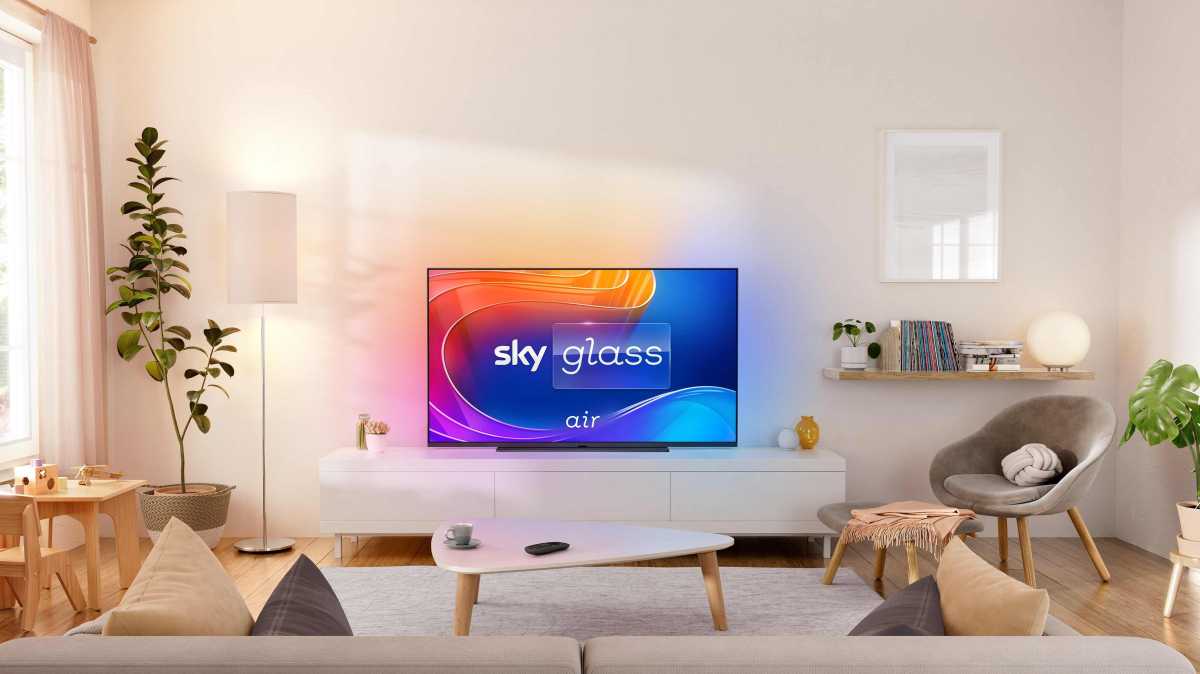
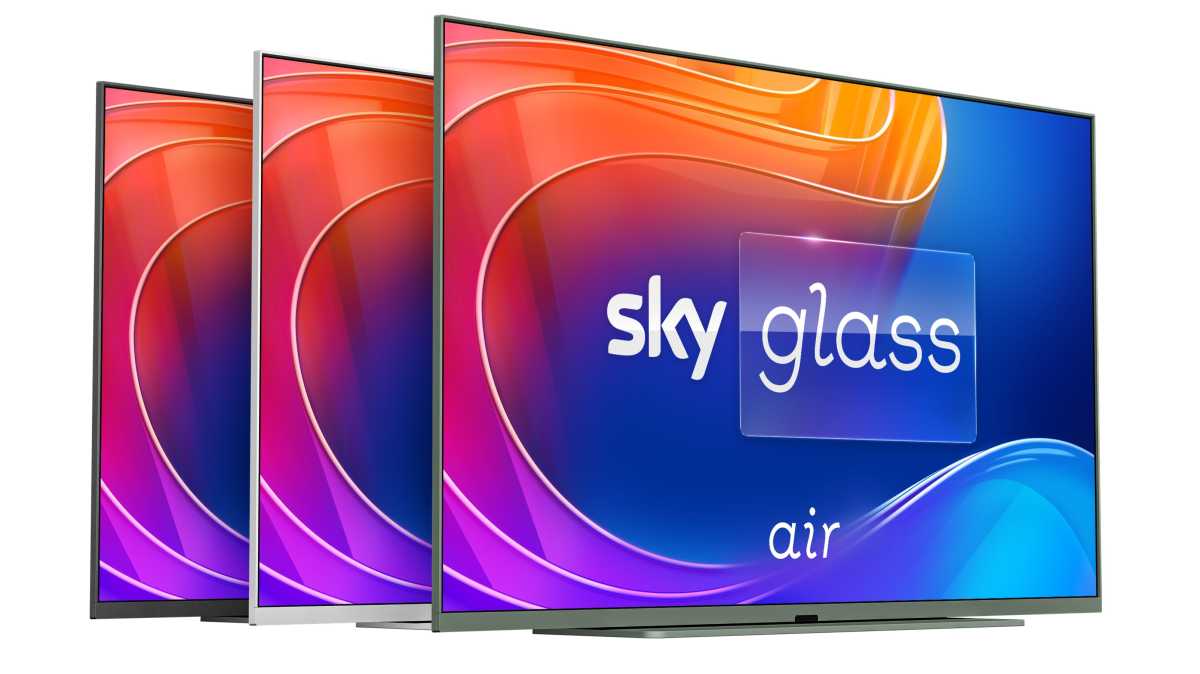
Sky has greatly simplified its telly proposition with Air. A simpler, lighter design, the screen now slots straight down onto its pedestal, with no awkward metalwork to wrestle.
Available in 43-, 55- and 65-inch screen sizes, the TV is offered in Sea Green, Carbon Grey or Cotton White colours. My review sample is the 65-inch white version, and it looks beautiful.
Unmistakably part of the Sky Glass family, Sky Glass Air echoes the sharp, clean aesthetic of its stablemate, Sky Glass Gen 2, but takes a significant leap forward in terms of practicality. Lighter, thanks mainly to the removal of the in-built Dolby Atmos sound system, it’s easier to wall mount or park on media units.

Steve May / Foundry
The colour frame, which I’m told contains 30 percent recycled plastic, has a subtle texture and sits proud of the display, creating a slightly three-dimensional effect. The screen itself is low on its colour-matched central stand; it looks great, but might be problematic if you’re planning on using a soundbar.
Sky Glass Air echoes the sharp, clean aesthetic of its stablemate, Sky Glass Gen 2, but takes a significant leap forward in terms of practicality
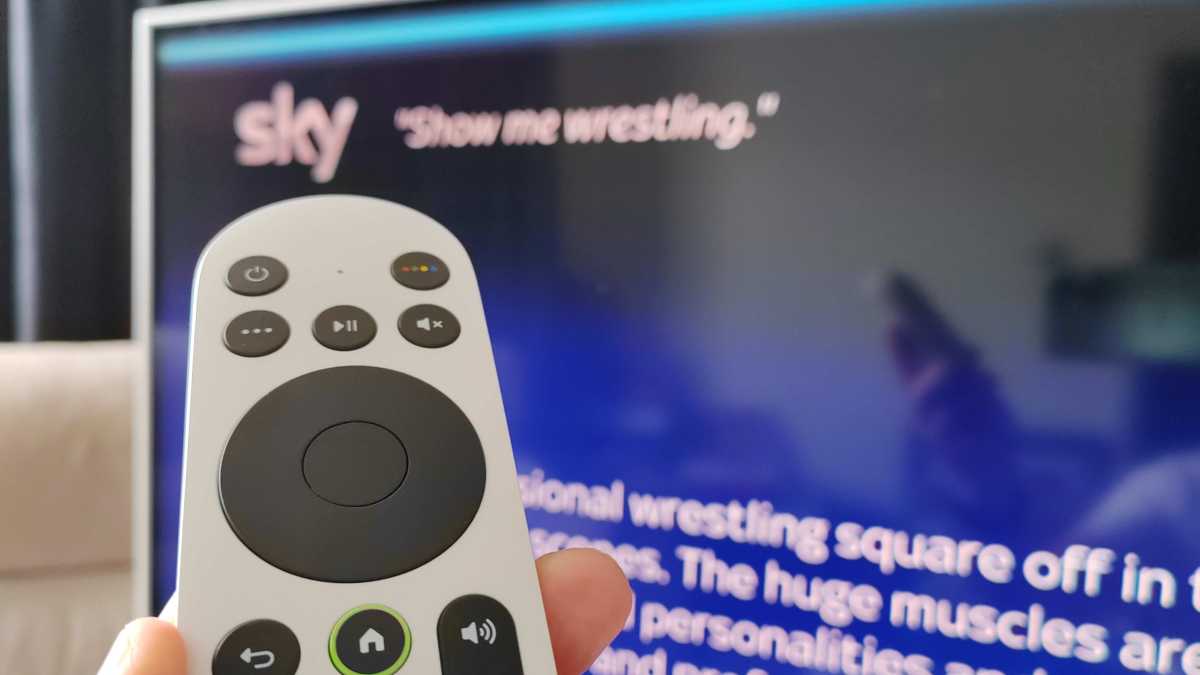
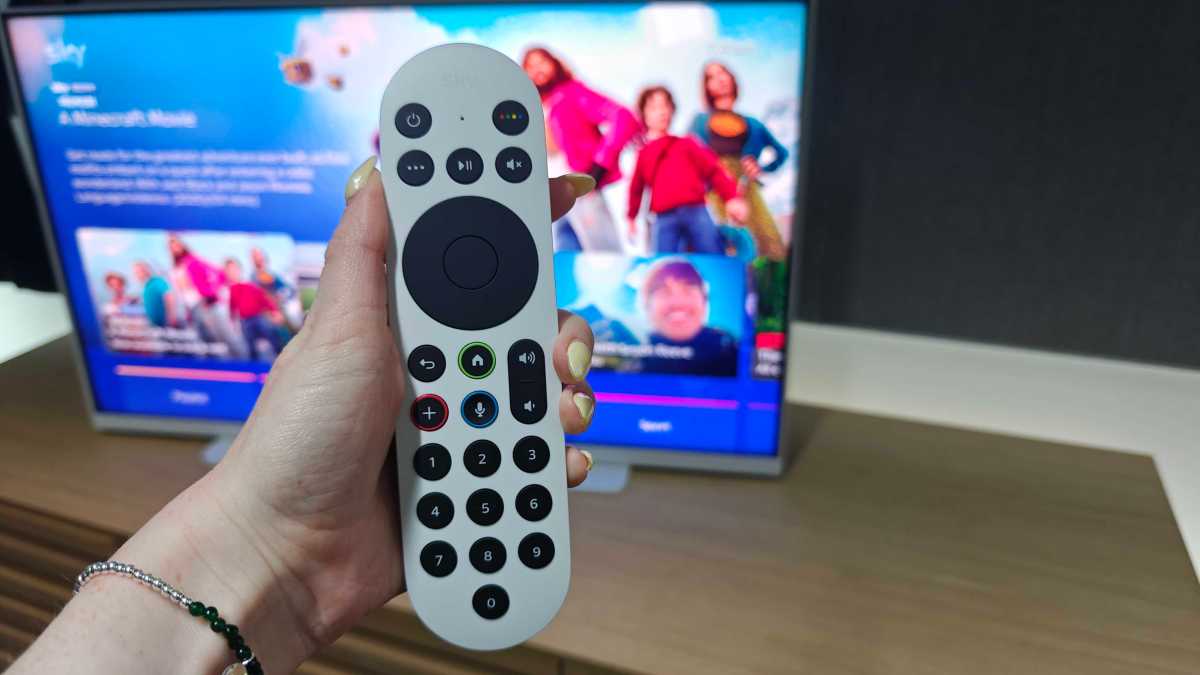
Similarly, the remote control is colour-matched to the TV’s frame and pedestal. Smart, but not backlit.
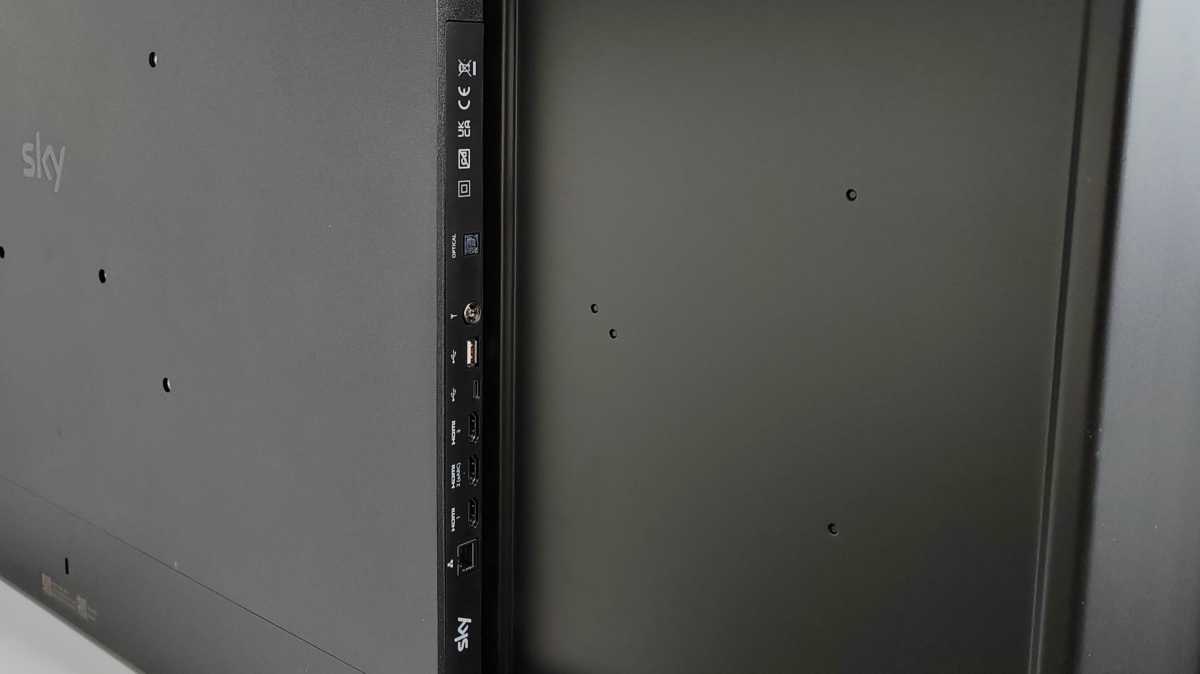
Connectivity comprises three HDMI slots, of which HDMI 2 supports eARC. There’s no high-frame rate gaming support, though, as this is a 60Hz panel. There are also two USB ports (USB-C port and USB-A), an optical digital audio output, and Ethernet to support Wi-Fi, and Bluetooth. There’s also a conventional terrestrial aerial input, although this is provided purely as a back-up; most users will choose to ignore it.
Steve May / Foundry
Display & Speakers
- Colour-rich Quantum Dot panel
- Underwhelming HDR
- 15W stereo sound system
Sky Glass Air uses a wide colour gamut 4K HDR Quantum Dot panel, with support for Dolby Vision, HDR10 and HLG.
It employs a full array backlight with global (not local) dimming, which has both strengths and weaknesses.
For everyday telly, viewed in a room lit by daylight or lounge lighting, it performs well. Average picture level is high, ensuring a balanced bright picture with most content sources. Fast-moving scenes play smoothly and there’s plenty of fine detail on display.
Steve May / Foundry
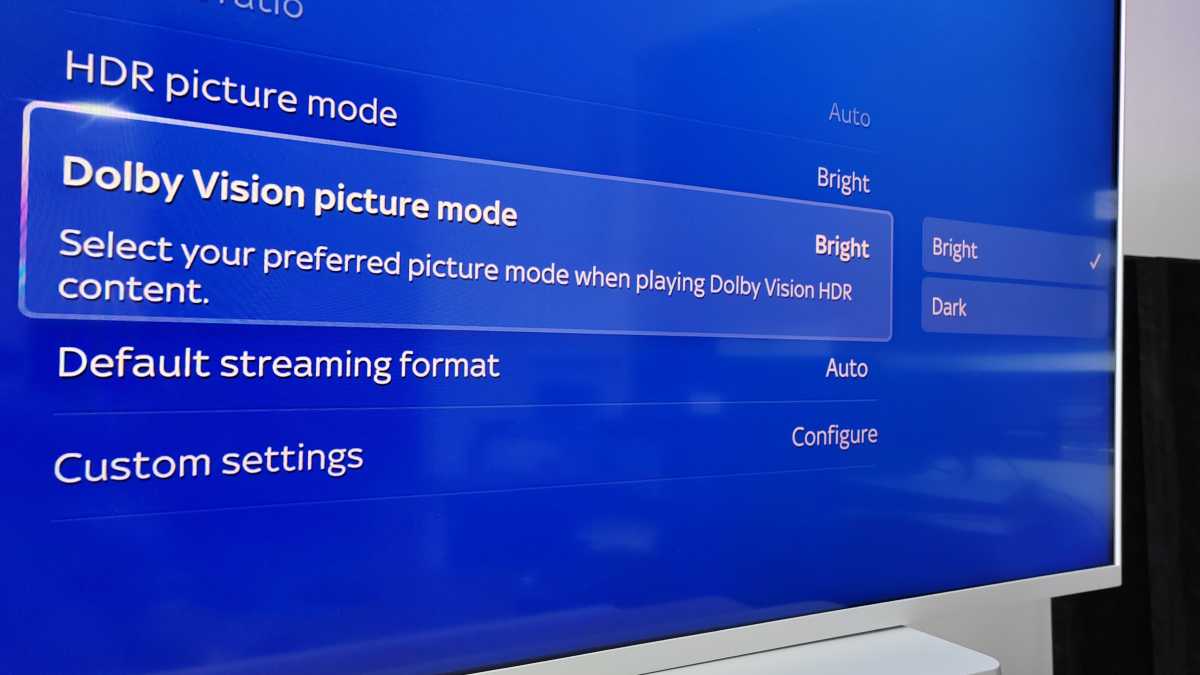
Sky Glass Air, like Sky Glass, does things a little differently to rivals when it comes to sound and vision management. For picture modes, the default is Auto, in which the set reacts specifically to genres of content as determined by Sky itself. This simplifies the viewing experience, but you are delegating image parameters to Sky. If you are not happy with Auto you can manually select Vivid, Extra Vivid, Entertainment, Sport, Movie, Music or adjustable Custom settings.
Of these, the most interesting is Extra-Vivid, which essentially cranks every element of the picture up to eleven. The result can look cartoonish, but some may actually like it. Bright primaries become luminescent.
If you do like your colours flashy, I’d suggest Vivid is the better option.
After a while, I simply opted to leave the screen in Auto mode, trusting it to produce an entirely presentable image appropriate for the content – and it pretty much did.
Steve May / Foundry
The TV’s HDR performance isn’t exactly going to set the world alight. The Air is more ‘HDR compliant’ than ‘HDR capable’. I measured its performance in multiple picture modes, and the results proved largely uniform, with an obvious exception. Extra-Vivid unlocks a peak brightness of 494 nits, using a 10 percent measurement patch.
Given I wouldn’t recommend this setting to actually watch anything, I would suggest 363 nits, as measured in Movie mode, is a more realistic indication of performance. While this isn’t a TV to make specular highlights gleam, it is uniformly bright with SDR and HDR content. Dolby Vision is on hand to optimise picture tone, scene-by-scene, on encoded content.
The screen’s biggest failing is arguably its gaming performance
Black levels are serviceable, but lack the inky depth of OLED or mini-LED TVs. For example, Netflix’s 3 Body Problem can be tonally quite dark with all its creepy interior shots, but there’s enough contrast available to keep the picture presentable.
Screen uniformity from the Direct Array backlight is good, although on a full black screen I did detect image pooling in the four corners of the panel.
I didn’t think this was an issue with live content, which appears stable and balanced. Animation, like Sky Cinema’s The Wild Robot, pops, and sports, particularly F1, shine.
Steve May / Foundry
On the sound side, Sky Glass Air boasts a basic 2 x 15W stereo speaker system. It’s far more modest than the Atmos-enabled speaker bar built into the larger Glass Gen 2, but it’s fine for everyday use. Dialogue remains clear in drama and news, and it handles blockbusters reasonably well. The good news is that you can stream Dolby Atmos out of the TV over HDMI eARC to a compatible Atmos soundbar, if you want to give your ears an upgrade.
The screen’s biggest failing is arguably its gaming performance. While my PS5 looked fine, the lack of 4K 120Hz support is painful. With 1080/60 content, latency was measured at a poor 67.5ms.
User Interface & Features
- Compatible with other Sky OS devices
- Personalised interface
- Cloud-based recording
Buy a Sky Glass TV and you’re not just getting a new telly, you’re embracing a complete user experience.
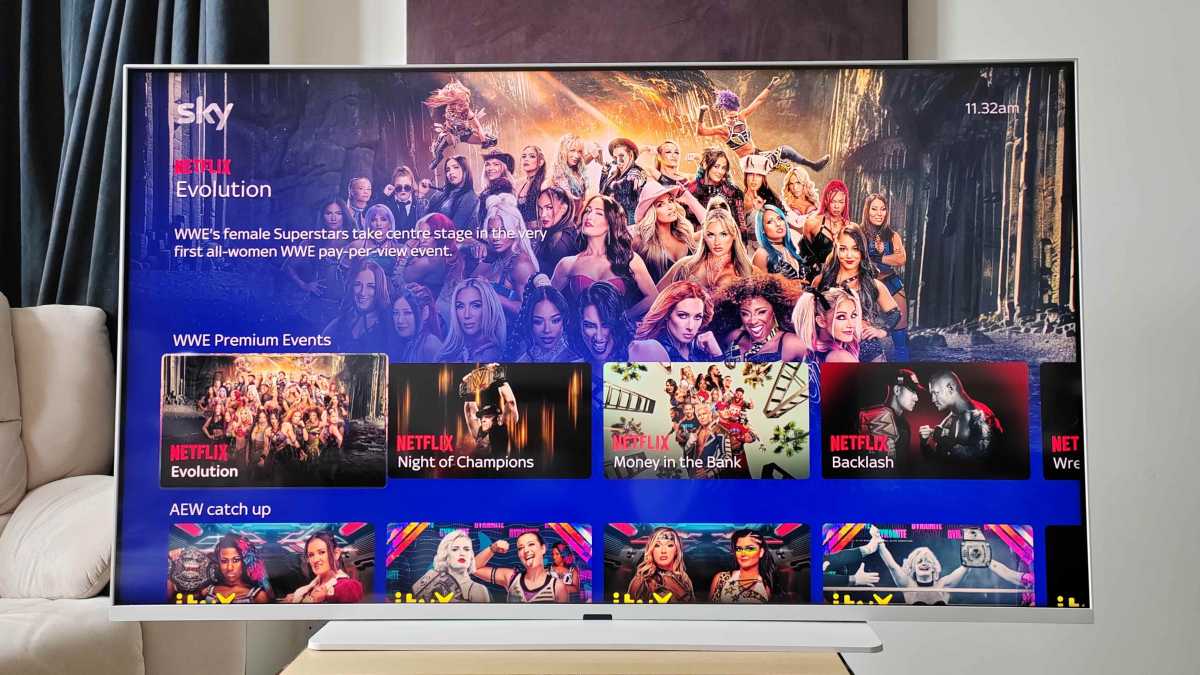
The Sky OS, seen on Glass Gen 2 and Sky Stream, is also the power behind Glass Air. It gathers live Sky channels and popular apps, including Netflix, BBC iPlayer, Prime Video and Disney+, in a unified, tiered interface, with personalised genre rails, playlists and a ‘Continue Watching’ bar. Voice control is standard and encouraged.
Steve May / Foundry
It’s intuitive to use, and thankfully free of the kind of advertisements that pepper rivals’ smart platforms, like Fire TV.
Want to record stuff? A cloud‑based DVR is your repository for selected TV shows and movies; a Series Link means shows are always available for catch-up – although this is subject to content rights limitations, which can be frustrating.
If you have multiple Sky Glass devices on your account, you can continue watching your Playlist across them all. It’s worth noting that Sky Q (the OG Sky set-top box) does not run Sky OS, and as such exists within its own ecosystem bubble.
Sky Glass Air is also not compatible with the Sky Live camera accessory.
It’s intuitive to use, and thankfully free of the kind of advertisements that pepper rivals’ smart platforms, like Fire TV
Price & Contracts
While Sky Glass Air is available for outright purchase, most buyers will opt for a contract on either 24- or 48-month terms. Your package is a combination of the hardware and whatever subscription package you add on top.
Sky Glass Air is available via Sky or Currys.
Steve May / Foundry
Here’s what you can expect to pay, depending on the size of the TV you opt for:
Sky Glass Air: Outright prices
- 43-inch – £309
- 55-inch – £509
- 65-inch – £649
Sky Glass Air: 24-month contract costs (including £20 upfront fee)
- 43-inch – £12 per month (£288 total cost)
- 55-inch – £20 per month (£480 total cost)
- 65-inch – £26 per month (£624 total cost)
Sky Glass Gen 2: 48-month contract costs (including £20 upfront fee)
- 43-inch – £6 per month (£288 total cost)
- 55-inch – £10 per month (£480 total cost)
- 65-inch – £13 per month (£624 total cost
A Sky Essentials basic channel bundle is available from £21 per month. This includes Sky Atlantic, Netflix Standard with Ads, Discovery+ and free-to-air channels such as BBC, ITV, Channel 4, Sky News and Sky Arts. Additional package options include Sky Ultimate TV (+£7/month), UHD and Dolby Atmos (+£6), or ad-free viewing (+£6).
Hannah Cowton-Barnes / Foundry
Should you buy Sky Glass Air?
If you’re seeking a good-looking TV that bundles copious live and on-demand channels in one affordable package, that can be used in virtually any room, then Sky Glass Air warrants a hard recommendation. Be warned, though, that subscription bundles and extras like UHD do add up.
However, if you’re a gamer, or cinephile seeking the deepest contrast and local recording flexibility, Sky Glass Gen 2 or a separate TV plus soundbar may be a better option.
You can see our full comparison of both TVs in our Sky Glass 2 vs Sky Glass Air piece.
Specs
- Display technology: QLED
- Resolution: 3840 x 2160 4K
- Screen sizes: 43, 55, 65-inch
- Refresh rate: 60Hz
- HDMI: 2.1 x3 (one eARC)
- HDR support: Dolby Vision, HDR10, HLG,
- Freeview tuner (back-up only)
- Dimensions: 1453 x 840 x 77 mm (with stand)
- Weight: 20.1kg (with stand)
Best Prices Today: Sky Glass Air
Author: Steve May, Contributor, Tech Advisor

With more than 25 years experience in the industry, Steve May is a home entertainment technology specialist with a penchant for big screens and immersive sound systems. Creator of Home Cinema Choice magazine, Steve is also the editor of lifestyle website The Luxe Review and edits professional custom install magazine Inside CI.